
VASP approval: what it means, when it is compulsory and how to avoid it
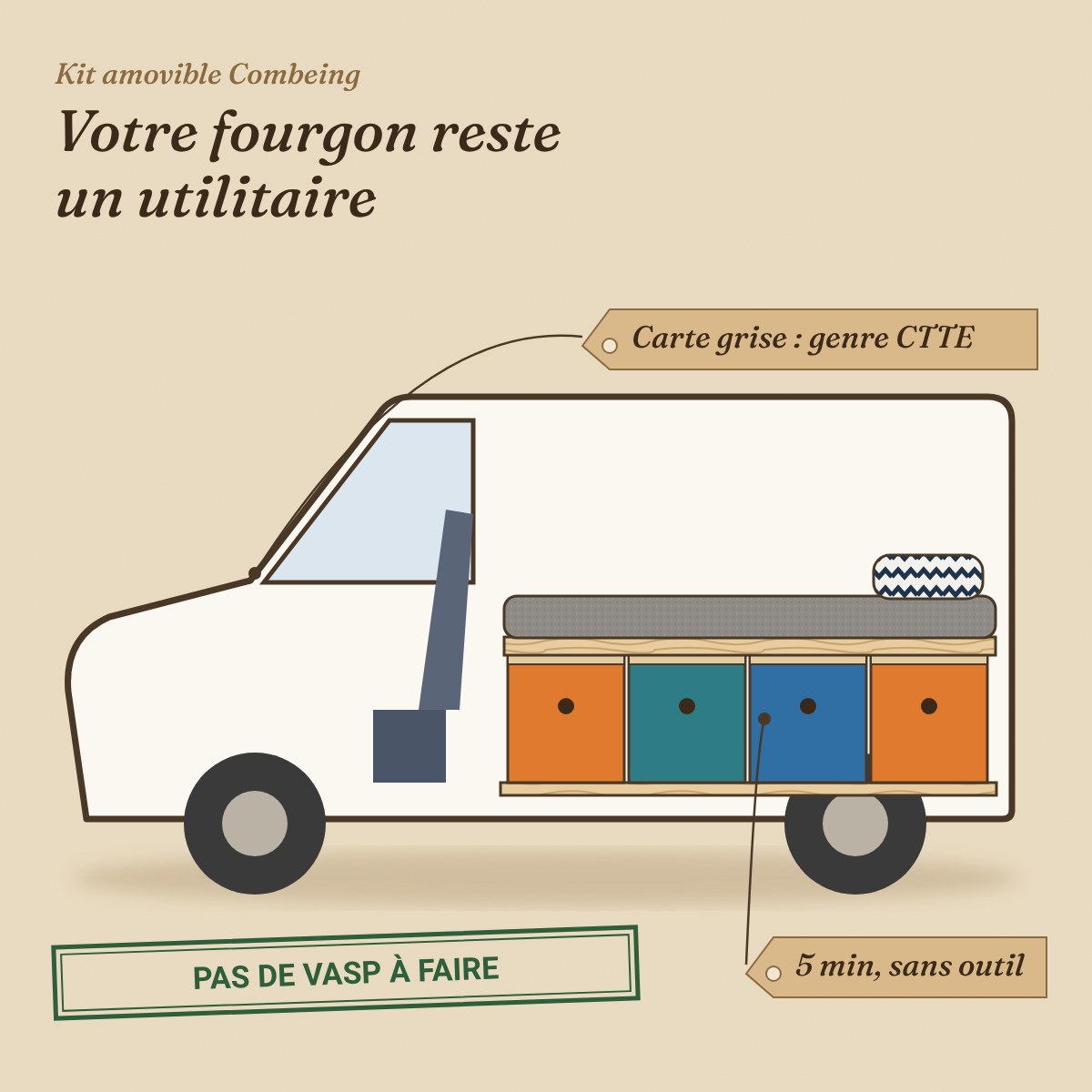
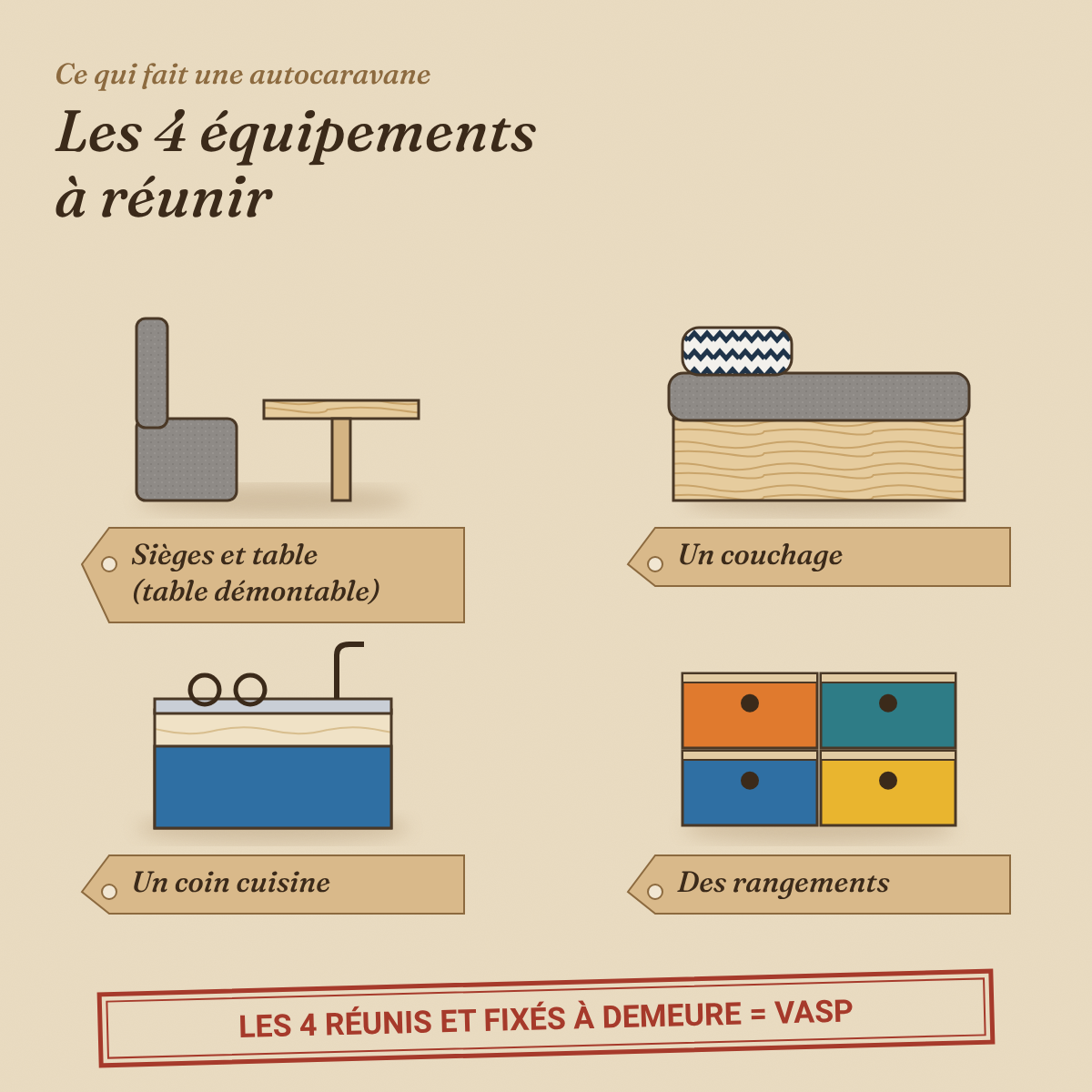
VASP approval officially turns a panel van into a motorhome on its registration certificate. It becomes compulsory when your van combines four living features, all permanently fixed: seats and a table, a bed, a kitchen and storage. As long as your conversion stays removable, your van remains a commercial vehicle, with no paperwork and no visit to the DREAL (the French regional authority that approves vehicles). Here is everything you need to know to make an informed choice, with the official texts, the real prices… and a few anecdotes that even some professionals don't know.
The essentials in 30 seconds
- VASP stands for “véhicule automoteur spécialisé” (specialised self-propelled vehicle). For a converted van, the registration certificate shows the VASP category and the CARAVANE body type.
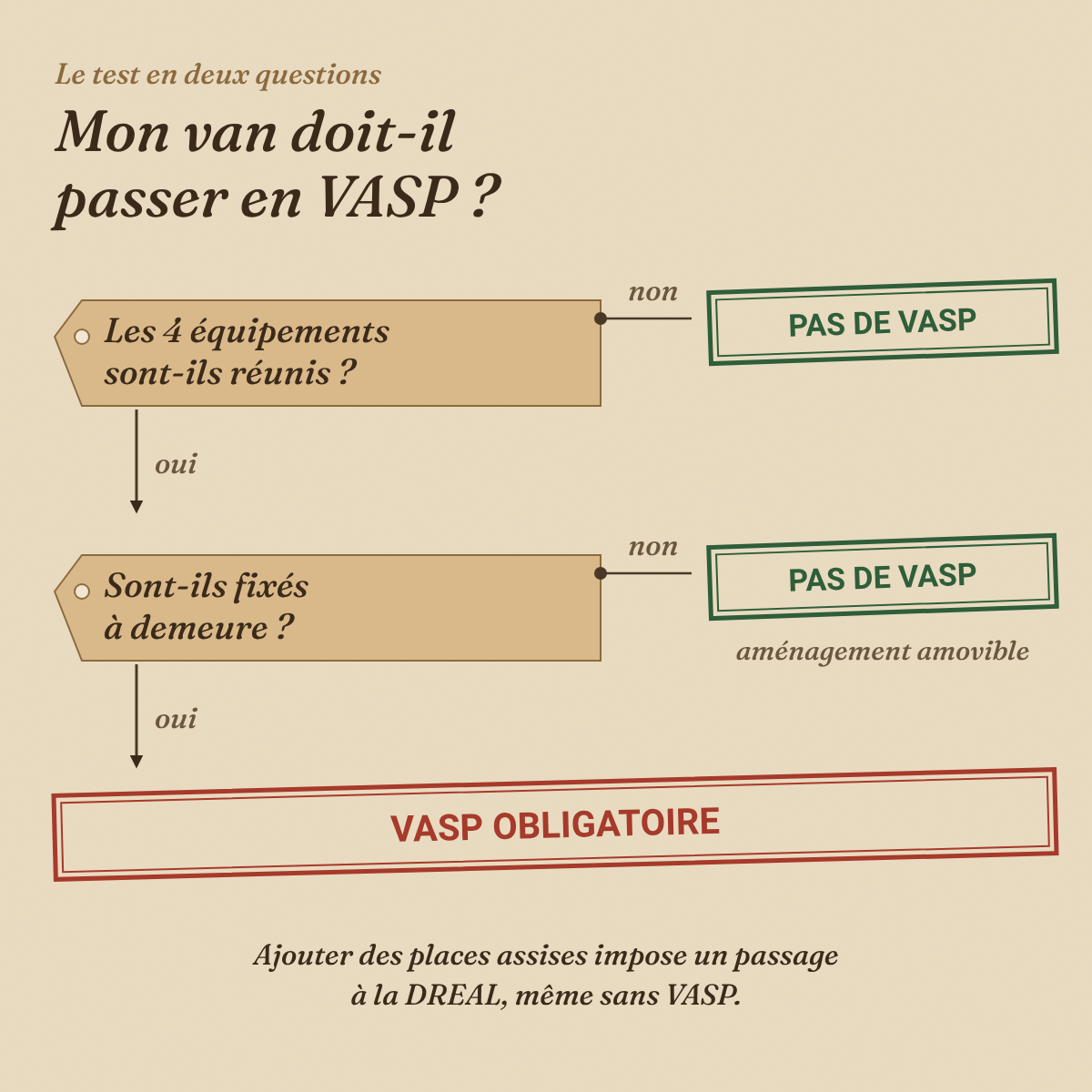
- VASP is compulsory if your van combines all four features of a motorhome, all of them permanently fixed.
- A fixed bed on its own, windows or a pop-top roof fitted properly, or removing the bulkhead do not turn your van into a motorhome.
- Allow €400 to €800 for the procedures and several months, not counting equipment that meets the standards.
- With a removable kit like those from Combeing, the van remains a commercial vehicle: you simply present it empty at the MOT-style technical inspection (contrôle technique).
Contents
What does VASP mean?
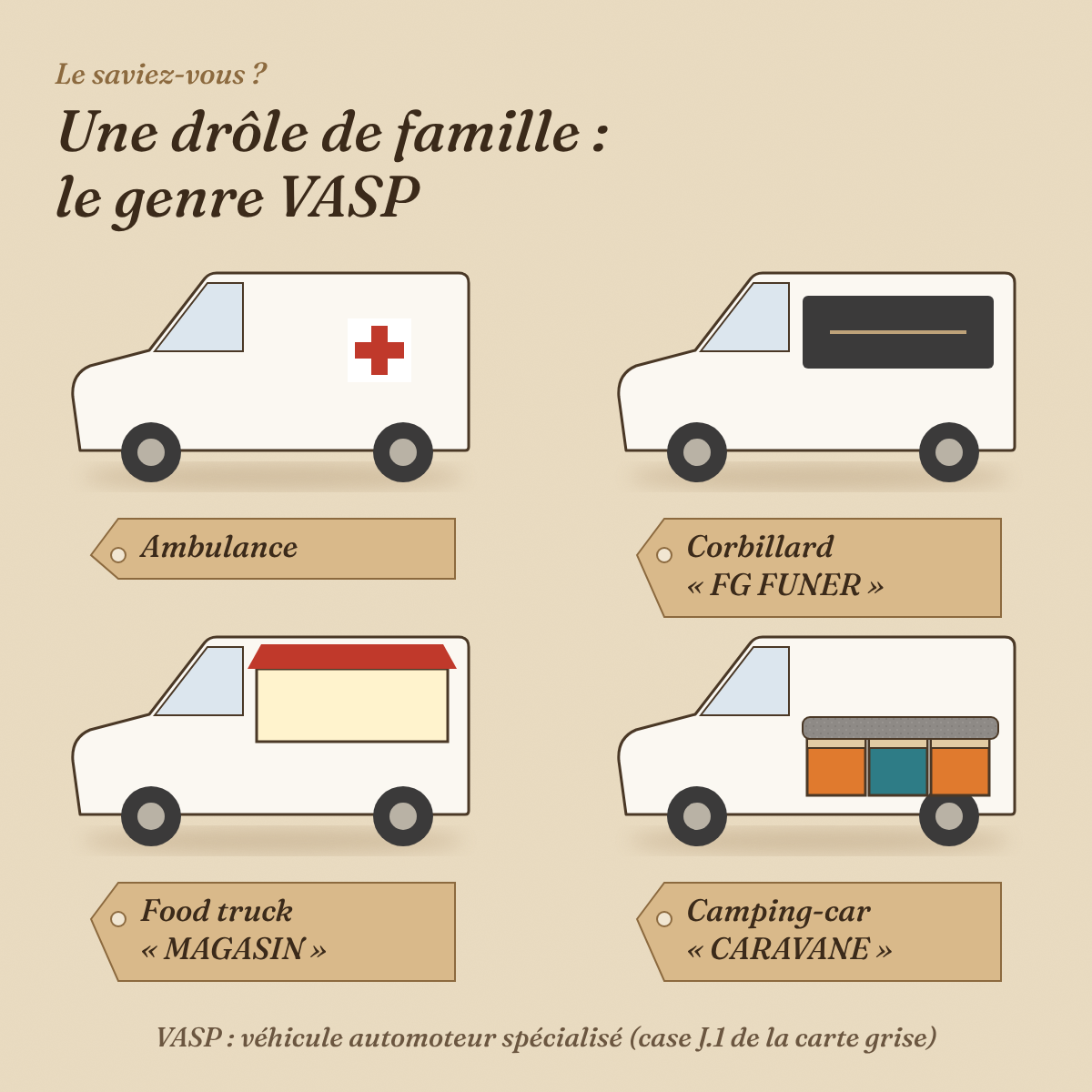
VASP stands for véhicule automoteur spécialisé (specialised self-propelled vehicle). It is an administrative “category”, entered in box J.1 of the registration certificate (carte grise), which covers all vehicles adapted for a particular use. For a van converted into a motorhome, the registration certificate shows the VASP category and the “CARAVANE” body type in box J.3. The vehicle then moves into the European category M1, that of passenger-carrying vehicles, whereas a commercial van is an N1 of the CTTE category (light commercial vehicle).
You often read “véhicule automoteur spécialement aménagé” (specially converted self-propelled vehicle): that expression is wrong, even though it sums up the idea well. Above all, remember that VASP is not a quality label or a certificate to frame. It is simply the way your vehicle is registered, so that the paperwork describes what it has become.
Did you know?
Once approved, your van shares its registration category with ambulances, food trucks (“MAGASIN” body type) and… hearses, whose body type is written “FG FUNER”. And the authorities officially call your motorhome a “CARAVANE” (caravan), even though it has an engine.
When is VASP approval compulsory?
The four features of a motorhome
The definition comes from European law (Regulation (EU) 2018/858, Annex I), as applied by the DREAL. A motorhome is a vehicle whose living space includes at least:
- seats and a table;
- a bed, which may be made by converting the seats;
- a kitchen area;
- storage.
And above all, these features must be rigidly secured to the living area. Only the table may be removable. A water supply, a shower or a toilet are not part of the criteria, contrary to what you sometimes read: you need all four elements, not “four out of five”.
What the ministry settled in 2018
When the technical inspection rules were reformed in May 2018, many van owners panicked. A member of parliament questioned the government, and the answer published in the Journal officiel (the French official gazette) on 31 July 2018 is crystal clear. A vehicle must be registered as VASP “caravane” when it has these features and they are “inamovibles” (permanently fixed). Those with only some of them “must not be considered as VASP caravane”, and the technical inspectors have been informed.
What does not turn your van into a VASP
- A fixed bed, even bolted down, and storage: without a fixed kitchen, it is not a motorhome.
- A portable stove that you take out to cook, instead of a hob permanently connected. Our guide to the removable gas stove for a converted van details the options.
- Insulation and lining of the walls, such as sprayed cork insulation.
- Removing the bulkhead: we have demonstrated it, text by text, in our article on the bulkhead of a commercial van.
- A pop-top roof or windows, fitted by an authorised professional with the vehicle manufacturer's permission: your van remains a commercial vehicle. Our workshop in Cleppé, in the Loire, fits pop-top roofs and windows in this way. To choose well, see our guide to the window for a converted van.
The case where the DREAL is required, even without VASP: seats
Adding seats changes the number of seats recorded on the registration certificate. You then need an individual approval (réception à titre isolé) from the DREAL, even if the van remains a commercial vehicle: this applies if you want to add a rear bench seat to a van. More broadly, any change to a characteristic recorded on the registration certificate goes through this procedure.
VASP or CTTE: what really changes?
Switching to VASP is not just a line on the registration certificate. Here are the practical day-to-day differences, for a vehicle under 3.5 tonnes.
| Subject | Commercial vehicle (CTTE, N1) | Motorhome (VASP caravane, M1) |
|---|---|---|
| Use | Goods transport, removable conversion possible | Habitable vehicle, fixed conversion |
| Technical inspection | At 4 years, then every 2 years, + emissions check every intermediate year | At 4 years, then every 2 years, with no intermediate emissions check |
| Future modifications | Free as long as the conversion remains removable | Any major modification goes back through the DREAL |
| Insurance | Commercial vehicle policy: get written confirmation of what covers the conversion | Motorhome policy, designed to cover the conversion |
| VAT for a business | Recoverable depending on the number of rows of seats and the equipment | Not recoverable (category M) |
| Resale | Sells as a commercial vehicle, the kit is sold separately | Easier to resell as a finished motorhome |
| Licence, speed, tolls | No difference: category B licence, same limits, toll calculated on the height of the vehicle | |
Did you know?
A commercial vehicle must go back every intermediate year for an additional emissions check. A motorhome with VASP approval is exempt, as it follows the schedule for passenger cars. At toll booths, however, the registration certificate makes no difference: the class depends on height. A van over 2 metres pays class 2, whether it is a commercial vehicle or a motorhome.
How do you obtain VASP approval?
The procedure is called an individual approval (réception à titre isolé, RTI) and takes place in four steps, in this order. The appointment at the DREAL is only set once the complete file has been received: allow several months between the end of the work and the new registration certificate.
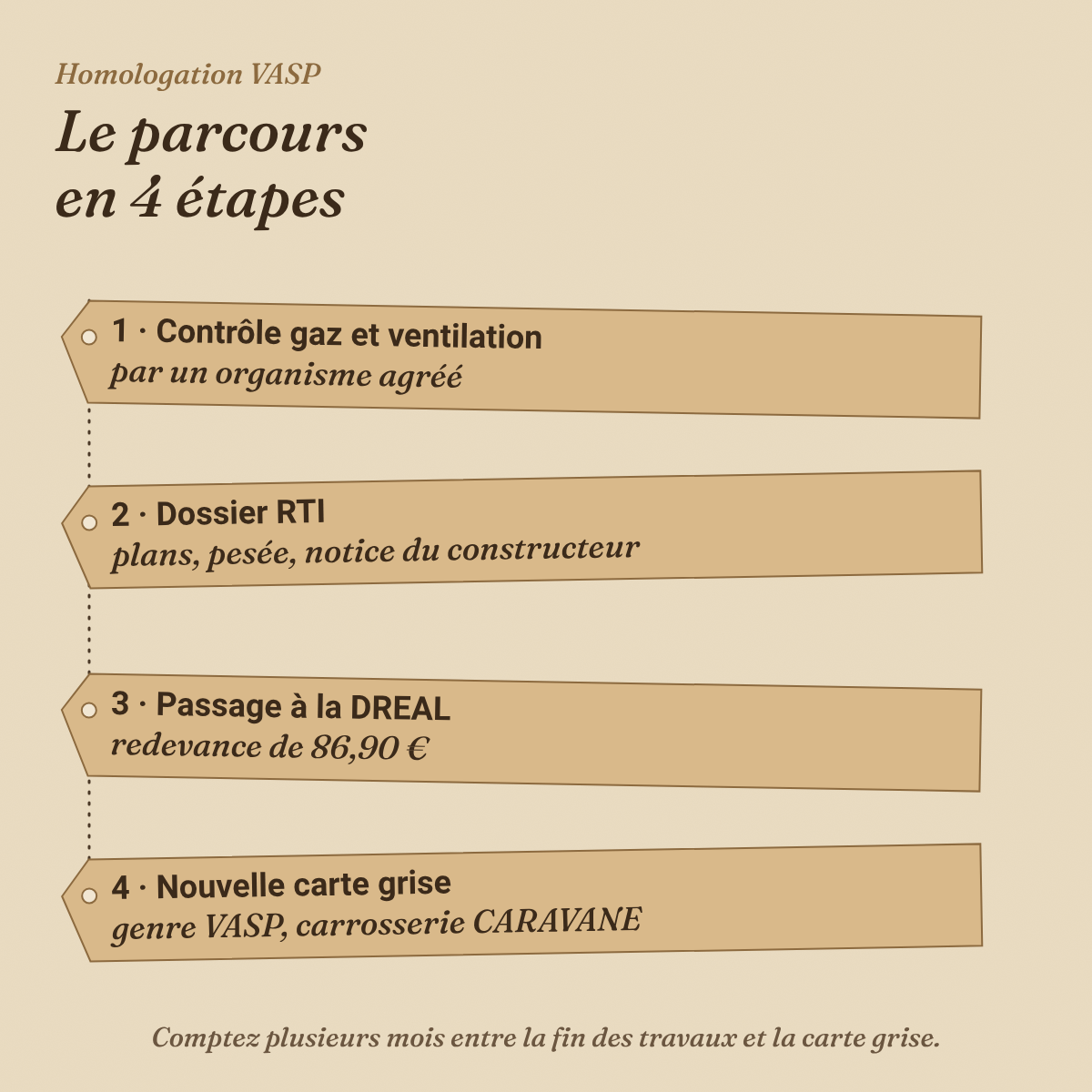
- Have the living area inspected. An approved body (Qualigaz, Bureau Veritas…) checks the gas installation to standard EN 1949 and the ventilation to standard EN 721, then issues a certificate of conformity.
- Put together the RTI file. It includes in particular the approval application, the certificate of work carried out, the vehicle's descriptive notice or original certificate of conformity, dimensioned plans, a weighing ticket and the load distribution calculation, photos, the test reports for added seats and seat belts, the heater data sheet and a technical inspection report for a vehicle over 4 years old.
- Present the van at the DREAL. The inspector checks that the vehicle matches the file, has the conversion plate fitted and collects the fee of €86.90, paid by cheque.
- Update the registration certificate with the ANTS (the French vehicle registration agency), using the approval report. The category becomes VASP, the body type CARAVANE.
The technical rules that surprise people
- Seats and seat belts: every added seat must be justified by tests (UN Regulations Nos. 14, 16 and 17).
- Glazing: approved and marked, except for small plastic elements under 200 cm² outside the field of vision.
- Interior fittings: no sharp edges in front of the rearmost seat.
- Heating: it must comply with UN Regulation No. 122, which only allows liquid or gas fuel heaters and electric heaters.
Did you know?
The pretty wood-burning stove in Instagram photos will never pass approval: the heating regulation simply does not provide for that type of appliance. Another surprise: the DREAL checks that you have a minimum payload left. You subtract the van's weighed mass and 75 kg per seat from the GVW (maximum authorised weight); what remains must exceed 10 kg per seat plus 10 kg per metre of length. A van overloaded with solid wood furniture can fail on that simple calculation.
The deadline for the registration certificate
After a conversion that changes the vehicle's characteristics, you must apply for a new registration certificate within one month of the end of the work, or face a fine of up to €750, according to service-public.fr.
How much does VASP approval cost?
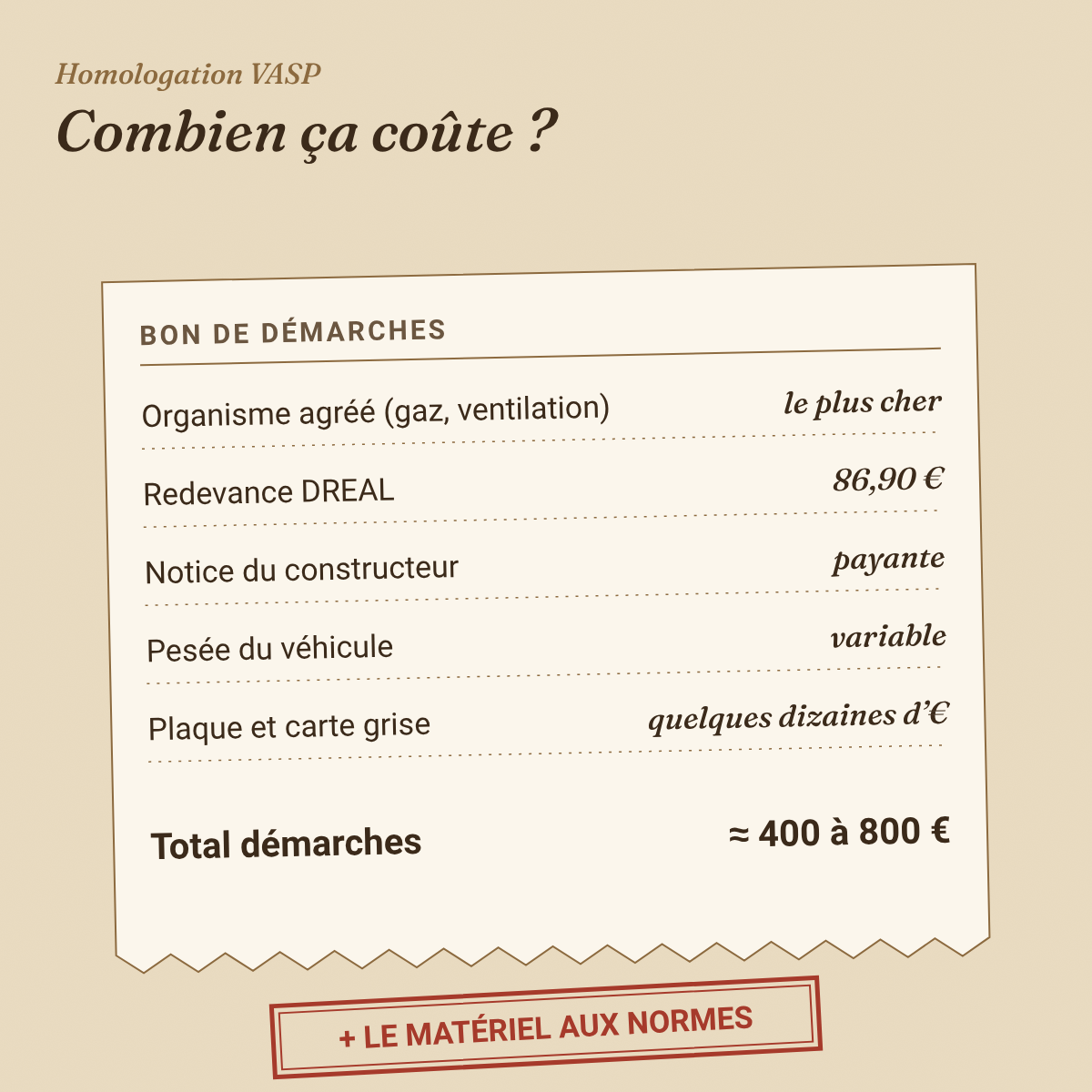
The only official fee is the DREAL's: €86.90. Everything else depends on your conversion, the body you choose and your region. Published accounts and guides put the procedural costs between €400 and €800.
| Item | Cost |
|---|---|
| Gas and ventilation check by an approved body | Variable, generally the biggest item (a few hundred euros) |
| DREAL approval fee | €86.90 |
| Manufacturer's descriptive notice | Chargeable, price set by each brand |
| Weighing the vehicle | Varies depending on the weighbridge |
| Conversion plate and registration certificate | A few tens of euros |
The real budget lies elsewhere: the equipment that meets the standards (gas installation, approved heater, tested seats and seat belts), the hours spent on the file and any re-inspections. This is often what makes people give up, rightly so, if they don't need a permanent motorhome.
What are the risks of a converted van that isn't approved?
It all depends on your conversion. If your van has genuinely become a motorhome, with fixed equipment, without the registration certificate being updated, three risks add up.
- The technical inspection: its role is to check that the vehicle matches its registration certificate. A van with a fixed conversion may be refused.
- The fine: up to €750 for failing to declare a conversion.
- Insurance: in the event of a claim, an insurer may contest the payout if the vehicle does not match what was declared.
Conversely, if your conversion is removable, you are perfectly within the rules. There is nothing to hide, and nothing to “get around”: a commercial vehicle carrying a removable conversion remains a commercial vehicle. And as for sleeping in it, no text requires VASP to sleep in a van.
The removable Combeing kit: a converted van without VASP approval
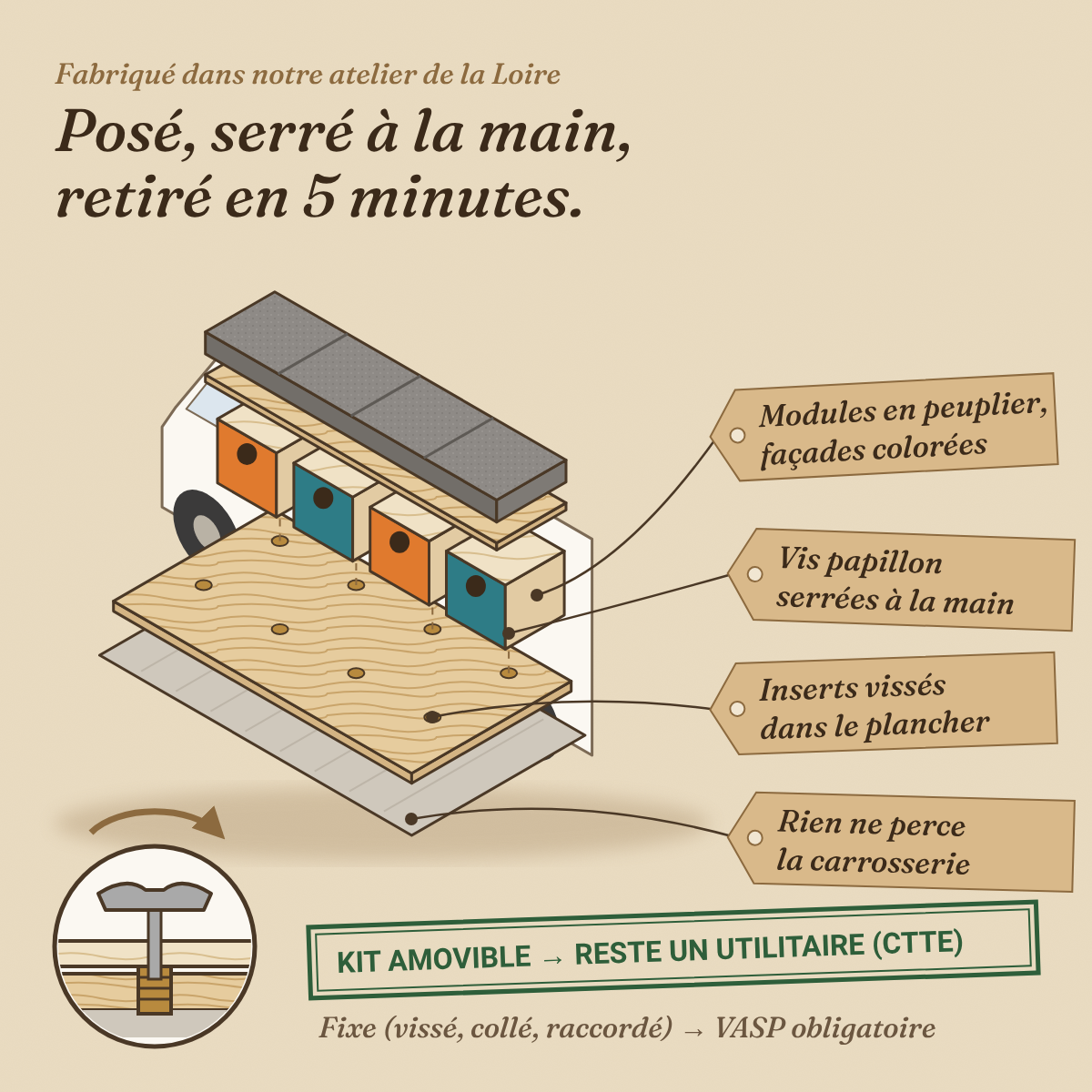
Our kits were designed from the outset with this question in mind, and it all comes down to two parts: screw-in inserts in the floor and thumb screws tightened by hand. The result: 5 minutes, without any tools, to fit the kit and to remove it. It holds firmly during the journey, but it is not “permanently fixed” equipment: your van remains a commercial vehicle, with its original CTTE registration certificate.
Why “no drilling” changes everything
Before buying a conversion sold as removable, ask a simple question: how is it fixed? If the answer involves screws into the bodywork, be wary. Every hole in the metal opens the door to corrosion, it must be properly filled before each technical inspection (a drilled floor can mean a re-inspection), and furniture screwed into the body is much harder to defend as “removable”. With our inserts and thumb screws, nothing pierces the bodywork: the day you sell your van, it is intact.
What you gain
- No file, no visit to the DREAL, no new registration certificate.
- Your commercial vehicle during the week, your camper van at the weekend.
- A kit that goes with you when you change vehicle.
- A budget of €3,000 to €4,000, far from the €50,000 and more of a new converted van.
Our tips for driving with peace of mind
- Present the vehicle empty at the technical inspection.
- Keep the assembly instructions on board: in a roadside check, they show that everything can be taken apart.
- Declare the value of the kit to your insurer and get written confirmation of how it is covered.
- Cook with a kitchen unit or a portable stove, ensuring good ventilation.
Our removable kitchen unit, for example, combines a sink, a water tank and two gas burners, but it comes out so you can cook outside, on a picnic table, and the gas bottle is never permanently connected to the vehicle. That is the whole difference from a motorhome kitchen.
Your converted van, without the paperwork
Removable bed, storage and kitchen, compatible with more than 300 vehicle models.
Discover our van and panel van conversion kitsFrequently asked questions about VASP
Article up to date as of November 2026, written using Regulation (EU) 2018/858, the DREAL Pays de la Loire and Nouvelle-Aquitaine approval sheets, service-public.fr and the ministerial answer of 31 July 2018. It does not replace the advice of your region's DREAL for a specific project.


